Valuing your work
Without a budget, work value is tracked time multiplied by the resolved rate. With a budget, the budget is the price and Out-of-scope work stays separate.
Without a budget: hours × rate
If a phase has no budget, its value grows with the time you track. Phased multiplies the original-scope hours by the rate that applies to that phase.
The rate comes from the most specific place where you set one: the phase, then the project, then your workspace default. Track 10 hours at 80 per hour and the work is valued at 800. Track another 5 hours and it becomes 1,200.
With no budget there is no agreed amount to measure the hours against, so budget health reads No budget. The effective rate is the same as the resolved hourly rate.
With a budget: the budget sets the price
Adding a budget changes the model. The budget becomes the agreed price for the phase. Tracked time shows how efficiently you are delivering it. The budget is a warning and profitability target, not a limit on how much time you can record.
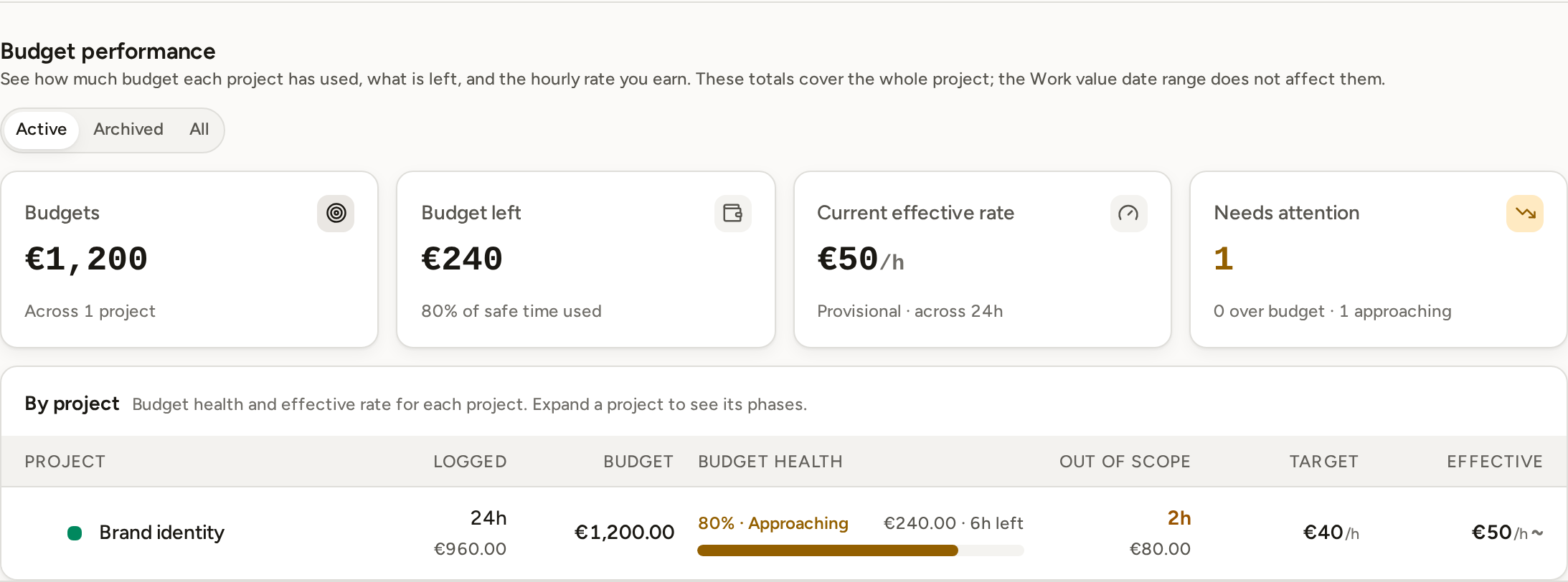
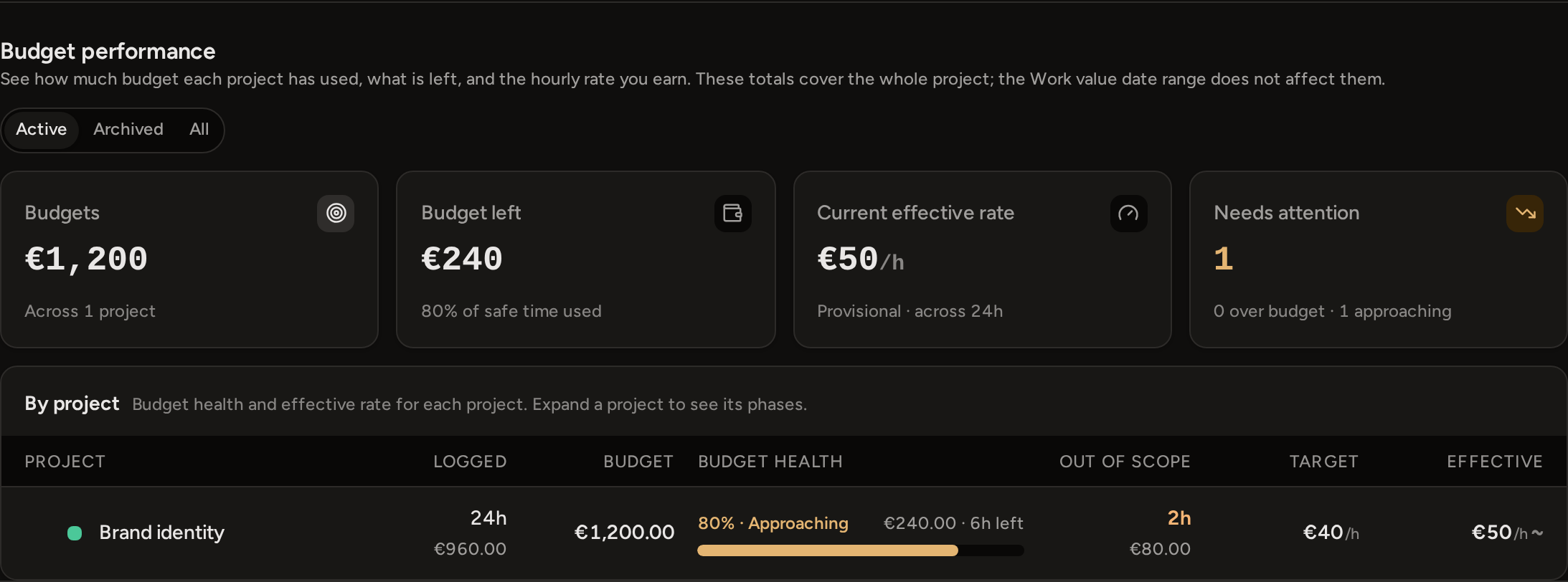
A phase priced at 2,000 has an effective rate of 100 per hour after 20 original-scope hours. Finish in 16 hours and the rate is 125. Take 25 hours and it falls to 80. The agreed price stays 2,000 in each case.
- A money budget preserves the amount you entered. Its matching hours are worked out from the current resolved rate.
- An hours budget preserves the time you entered. Its money price is worked out from the current resolved rate.
- Changing a live budget or rate immediately recalculates the price, health and effective rate wherever that value depends on the change. Reports you already created keep their frozen amounts and work.
Out-of-scope work stays separate
Budget health and the phase's effective rate use only time in the original scope. Time you explicitly mark Out of scope is removed from that budget calculation. It is priced separately at the resolved hourly rate.